You’re standing in your backyard watching a downpour soak into the ground. Thousands of gallons roll off your roof and disappear into the storm drain. You think: why not catch some of that for your garden?
Then a neighbor mentions something about rainwater collection being illegal. You wonder if putting a barrel under your downspout could actually get you in trouble with the law.
Here’s what surprises most people: rainwater collection is legal in every US state, but the rules vary wildly. Some states encourage it with tax credits. Others require permits or cap how many gallons you can store. A few have restrictions tied to century-old water rights doctrines you’ve never heard of.
This guide breaks down the actual laws in 2026, state by state. You’ll learn which states restrict collection, why those restrictions exist, what penalties look like, and exactly what you can do legally where you live.
Is It Illegal to Collect Rainwater
Collecting rainwater is not illegal anywhere in the United States as of 2025. Every state allows some form of residential rainwater harvesting, though regulations differ significantly in scope and requirements.
Say you want to set up a simple rain barrel under your gutter. In most states, you can do this without any permits, registration, or government notification. About 35 states have no restrictions whatsoever on residential rainwater collection.
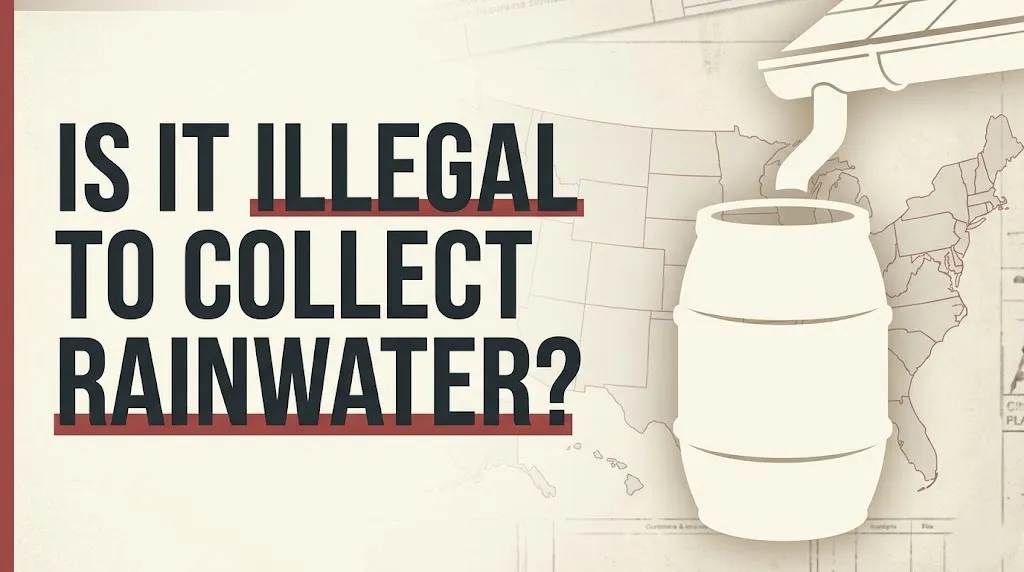
The legal reality is straightforward for most Americans. If you live in the eastern half of the country, you can collect as much rainwater as you want from your property. Western states tend to have more rules because of how water rights developed historically in arid regions.
The confusion comes from a few states that used to heavily restrict collection. Colorado famously prohibited residential rainwater harvesting until 2009. Utah required state permits until recent reforms. These historical restrictions created the widespread myth that rainwater collection remains broadly illegal.
| State Category | Number of States | Permit Required | Gallon Limits |
|---|---|---|---|
| No restrictions | 35 | No | None |
| Minor restrictions | 12 | Sometimes | Varies by state |
| Significant rules | 3 | Yes or registration | Specific caps |
In states with restrictions, the rules typically involve one of three things: limits on total collection capacity, requirements to register your system, or rules about how you can use the water. Restrictions almost never mean a complete ban.
Why Is It Illegal to Collect Rainwater
Rainwater collection restrictions exist because of a legal doctrine called prior appropriation, which treats water as a resource that belongs to whoever claimed it first rather than whoever owns the land where it falls.
Picture a farmer in 1890 Colorado who built an irrigation system fed by a creek. Under prior appropriation, that farmer’s water right is protected by law. Any water that would naturally flow to that creek, including rain that falls on land upstream, technically belongs to the creek and its prior appropriators.
This legal framework developed in the western United States during the 1800s. Settlers in arid regions needed certainty about water access. The “first in time, first in right” principle gave early water users permanent legal claims. States codified these claims into formal water rights systems.
When you collect rainwater from your roof in a prior appropriation state, you’re theoretically diverting water that would otherwise seep into the ground, recharge aquifers, and eventually reach streams or reservoirs. Prior appropriation doctrine says that water already belongs to someone else: the holders of senior water rights downstream.
This is why Colorado, Utah, and other western states historically restricted rainwater collection. The restrictions protected existing water rights holders from having their supply diminished by residential collection upstream.
State Spotlight: Colorado, Utah, and Nevada all developed their water law systems around prior appropriation. Eastern states like Ohio, Georgia, and Florida use riparian rights instead, which tie water use to land ownership and rarely restrict rainwater collection.
The practical effect matters less than the legal theory. Hydrological studies have shown that residential rainwater collection has minimal impact on downstream water supplies. Most collected rainwater gets used for landscaping and eventually reaches the same watershed anyway.
What States Is It Illegal to Collect Rainwater
No state makes rainwater collection completely illegal, but Colorado, Utah, and Nevada impose meaningful restrictions that require compliance with specific rules.
Imagine you just moved from Pennsylvania to Denver. Back east, you had three 55-gallon rain barrels with no paperwork involved. In Colorado, you need to understand the state’s gallon cap and permissible uses before setting up the same system.
Colorado limits residential collection to 110 gallons maximum, stored in two barrels or fewer. The water must be used for outdoor purposes on the same property where it’s collected. You don’t need a permit, but you must follow these rules or face potential violations.
Utah restricts collection to 2,500 gallons if you register your system with the state. Without registration, the limit drops to 100 gallons. Registration is free and can be done online through the Utah Division of Water Rights.
Nevada requires a waiver from the State Engineer for any rainwater collection system. The state treats collected rainwater as belonging to the public, so you need permission to divert it for personal use.
| State | Restriction Type | Limit | Permit or Registration |
|---|---|---|---|
| Colorado | Gallon cap | 110 gallons | No permit required |
| Utah | Gallon cap | 2,500 gal with registration | Free online registration |
| Nevada | State permission | Varies | Waiver from State Engineer |
| Oregon | Conditional | Usually none | Permit if using surface water |
| Washington | Conditional | Usually none | Must be from rooftop |
Several states have minor rules that affect specific situations without restricting typical residential collection. Oregon allows unrestricted rooftop collection but requires permits if you’re capturing water from other surfaces. Washington requires collection to be from rooftop surfaces only.
Legal Bottom Line: You can legally collect rainwater in all 50 states, but Colorado, Utah, and Nevada require you to follow specific capacity limits or registration requirements to stay compliant.
Where Is It Illegal to Collect Rainwater
Rainwater collection faces the most restrictions in western states that follow prior appropriation water rights doctrine, particularly Colorado, Utah, Nevada, and parts of Oregon and Washington.
Think about the map this way: draw a line roughly from Texas up through the Dakotas. States west of that line tend to have more water regulations because rainfall is scarcer and competition for water is higher.
The geographic pattern traces back to settlement history. Eastern states receive enough rainfall that water conflicts rarely occurred. Western states developed in an era of water scarcity, mining claims, and agricultural competition. Legal systems evolved to match those conditions.
| Region | Restriction Level | Common Rules |
|---|---|---|
| Western US | Higher | Gallon caps, registration, permits |
| Southwestern US | Moderate | Some use restrictions |
| Midwestern US | Low | Generally unrestricted |
| Eastern US | Minimal | No state-level restrictions |
| Southern US | Minimal | Often encouraged or incentivized |
Within restricted states, local ordinances sometimes add another layer. Some municipalities in restricted states have their own rainwater codes that differ from state law. A few cities in unrestricted states have HOA regulations or building codes that affect rainwater systems.
Water districts in California, Arizona, and New Mexico occasionally require notification for large-scale collection systems. These rules typically apply to agricultural or commercial operations rather than residential rain barrels.
State Spotlight: Texas and Arizona both actively encourage rainwater collection through tax exemptions and rebate programs, despite being in the arid Southwest. Their legal frameworks prioritize conservation over prior appropriation restrictions.
The trend over the past two decades has moved toward fewer restrictions. Colorado loosened its rules in 2009 and expanded them again in 2016. Utah simplified its registration process. No state has added new restrictions during this period.
Is It Illegal to Collect Rainwater in California
Collecting rainwater is completely legal in California with no permit requirements, capacity limits, or registration needed for residential use.
Say you own a home in Los Angeles and want to install a 500-gallon cistern system. California law not only allows this but actively encourages it. The state passed the Rainwater Capture Act in 2012, explicitly legalizing residential collection and exempting these systems from state water board regulation.
California’s legal framework treats rainwater harvesting as a conservation tool. Given the state’s recurring droughts and water shortages, the legislature decided that encouraging collection serves the public interest better than restricting it.
The 2012 law clarified that rainwater captured from rooftops belongs to the property owner. This resolved any ambiguity under California’s hybrid water rights system, which mixes prior appropriation and riparian doctrines.
Local incentives make collection even more attractive. Many California water districts offer rebates for rain barrel purchases. Los Angeles, San Diego, and other major metro areas run programs that subsidize residential rainwater systems to reduce stormwater runoff and conserve treated water.
| California Program | Benefit | Typical Amount |
|---|---|---|
| LA Rain Barrel Rebate | Cash rebate | Up to $35 per barrel |
| San Diego WaterSmart | Rebate program | Varies by district |
| Santa Clara Valley | Cistern rebate | Up to $500 |
Building codes in some California jurisdictions require new construction to include rainwater capture infrastructure. These rules treat collection as part of sustainable building standards rather than as something that needs permission.
The only practical limitations involve using collected rainwater for potable purposes. California health codes restrict using untreated rainwater for drinking without proper filtration and treatment systems that meet state standards.
Is It Illegal to Collect Rainwater in Texas
Texas not only makes rainwater collection legal but provides tax exemptions and actively encourages residents to harvest water from their property.
Imagine you’re building a new home in Austin and want to include a 5,000-gallon rainwater collection system for landscape irrigation. Texas law supports this completely. The state removed property tax value for rainwater collection equipment, meaning your system won’t increase your tax bill.
Texas Water Development Board has promoted rainwater harvesting since 2001. The state provides technical guidance, system design resources, and educational materials to encourage adoption.
Financial incentives extend beyond tax treatment. Texas exempts rainwater harvesting equipment from state sales tax. Some municipalities offer additional rebates or reduced water bills for homes with collection systems.
The legal framework in Texas reflects the state’s approach to water challenges. Facing recurring droughts and groundwater depletion, Texas chose to treat rainwater as a resource property owners should capture rather than let run off.
| Texas Incentive | Benefit Type | Details |
|---|---|---|
| Property tax exemption | Tax savings | Collection equipment excluded from value |
| Sales tax exemption | Tax savings | Equipment purchases tax-free |
| Local rebates | Cash rebates | Available in Austin, San Antonio, others |
Texas law requires new state buildings to incorporate rainwater collection if cost-effective. This mandate signals the state’s commitment to treating harvesting as standard practice rather than unusual activity.
No permits are required for residential systems of any size. Commercial and agricultural operations face some water quality rules if using collected rainwater for specific purposes, but residential landscape irrigation remains completely unrestricted.
Legal Bottom Line: Texas treats rainwater collection as a property right and provides financial incentives to encourage it. No permits, no limits, and tax benefits for installing systems.
Is It Illegal to Collect Rainwater in Colorado
Colorado allows rainwater collection but limits residential systems to two containers holding no more than 110 gallons total, with water restricted to outdoor use on the same property.
Picture this scenario: you just bought a house in Boulder and want to set up rain barrels. Unlike Texas or California, Colorado’s rules require attention to specific limits. You can install two barrels under your downspouts, but the combined capacity cannot exceed 110 gallons.
Colorado’s restrictions trace to its strict prior appropriation system. The state’s 1876 constitution declared all water to be public property subject to appropriation. For over a century, this meant rainwater collection was technically illegal because the water belonged to downstream rights holders.
Reform came in 2009 when the legislature passed HB 09-1129, allowing limited residential collection. The law expanded in 2016 to permit collection at any residential property, not just rural homes using well water.
| Colorado Rule | Requirement |
|---|---|
| Container limit | Maximum 2 barrels |
| Capacity limit | 110 gallons total |
| Permitted use | Outdoor purposes only |
| Property restriction | Same property where collected |
| Permit required | No |
The 110-gallon limit reflects a legislative compromise. Studies showed this amount represented typical residential use and had negligible impact on downstream water supplies. Larger collection would require formal water rights.
Violations of Colorado’s rainwater rules could technically result in enforcement by the State Engineer’s office. In practice, residential violations are rarely pursued unless they involve large-scale collection that infringes on documented water rights.
State Spotlight: Colorado’s evolution from complete prohibition to regulated permission illustrates how western water law is adapting. The state balanced prior appropriation principles with modern conservation needs by allowing limited collection while preserving the underlying water rights framework.
Is It Illegal to Collect Rainwater in Florida
Florida has no restrictions on rainwater collection and actively promotes harvesting through state environmental programs and local water management districts.
Say you live in Tampa and want to install a large cistern system to capture summer storm runoff. Florida law places no limits on how much you can collect, how you store it, or what you use it for. The state treats rainwater harvesting as part of responsible water management.
Florida’s legal framework reflects the state’s water abundance and stormwater management challenges. With average annual rainfall exceeding 50 inches in most areas, Florida focuses more on managing excess water than restricting its use.
Water management districts throughout Florida offer rainwater harvesting programs. The Southwest Florida Water Management District runs workshops and provides resources for residential collection. South Florida Water Management District includes harvesting in its conservation toolkit.
| Florida Water District | Program Available | Focus |
|---|---|---|
| Southwest Florida WMD | Yes | Residential education |
| South Florida WMD | Yes | Conservation resources |
| St. Johns River WMD | Yes | Technical guidance |
| Suwannee River WMD | Limited | Basic information |
No state permits are required for any residential rainwater system. Building permits may apply to large cistern installations that require structural work, but these are standard construction permits rather than water-specific regulations.
Florida does regulate certain uses of stored water. Health codes apply if you plan to treat and use rainwater for drinking. These rules focus on ensuring water quality rather than restricting collection itself.
Local governments in Florida occasionally offer rebate programs for rain barrel purchases. Check with your county extension office or water utility for current incentive programs in your area.
Is It Illegal to Collect Rainwater in Ohio
Ohio places no restrictions on residential rainwater collection, and the state encourages harvesting as part of stormwater management and conservation efforts.
Imagine you’re a homeowner in Columbus who wants to reduce water bills by irrigating your garden with collected rainwater. Ohio law creates no barriers. You can install barrels, cisterns, or larger systems without permits, registration, or capacity limits.
Ohio follows riparian water rights doctrine, which ties water use to land ownership. Under this system, landowners have rights to reasonable use of water on their property. Rainfall that lands on your roof is considered yours to use.
This legal framework differs fundamentally from prior appropriation states. Ohio never developed the “first in time, first in right” system that restricts collection in Colorado and Utah. Water rights attach to land rather than to historical claims.
Several Ohio cities run rain barrel programs that subsidize collection. Cleveland, Columbus, and Cincinnati have all offered discounted barrels or rebate programs at various times. These municipal programs treat harvesting as a stormwater management tool.
| Ohio Program Type | Availability | Purpose |
|---|---|---|
| Municipal rebates | Select cities | Reduce stormwater runoff |
| Rain barrel sales | Common | Conservation education |
| Extension workshops | Statewide | Technical guidance |
Ohio State University Extension provides resources on rainwater harvesting system design. The state agricultural extension service treats collection as a standard gardening practice rather than a regulated activity.
No Ohio statute addresses rainwater collection directly because no restriction exists. The absence of regulation means the activity is legal by default under Ohio law.
Legal Bottom Line: Ohio homeowners can collect unlimited rainwater with no permits, registration, or state oversight. The state’s riparian water rights system treats rainfall on your property as yours to use.
Is It Illegal to Collect Rainwater in Oregon
Oregon allows unrestricted rainwater collection from rooftop surfaces, but capturing water from other sources may require a water right permit under state law.
Picture owning rural property in the Willamette Valley where you want to maximize water collection. From your roof, you can collect unlimited amounts with no permit. If you want to capture water from a stream, pond, or other surface source, Oregon’s water rights system kicks in.
Oregon’s approach creates a clear distinction. Rooftop collection is exempt from regulation because the water would otherwise become stormwater runoff. Surface water collection requires permits because it affects the state’s managed water rights system.
The Oregon Water Resources Department administers water rights. Rainwater from rooftops falls outside their jurisdiction. Water from streams, springs, and other natural sources requires permits.
| Oregon Collection Type | Permit Required | Restrictions |
|---|---|---|
| Rooftop rainwater | No | None |
| Surface water | Yes | Water right permit needed |
| Groundwater | Sometimes | Depends on use |
Oregon law specifically states that landowners may use rainwater from artificial impervious surfaces without a water right. This language covers roofs, paved areas, and other constructed surfaces.
Large-scale commercial operations may need local permits for stormwater management reasons, but residential rooftop collection remains completely unrestricted regardless of system size.
The state’s environmental agencies view residential rainwater harvesting favorably. Oregon DEQ includes collection in guidance on sustainable residential practices. Municipal programs in Portland and other cities promote rain barrel adoption.
Is It Illegal to Collect Rainwater in Utah
Utah allows rainwater collection with registration, capping systems at 2,500 gallons for registered users or 100 gallons for those who don’t register with the state.
Say you want to install a substantial rainwater system at your Salt Lake City home. Utah requires you to register online with the Division of Water Rights before exceeding 100 gallons of storage capacity. Registration is free and takes minutes to complete.
Utah’s registration requirement reflects the state’s prior appropriation water law. The state tracks water use to protect existing water rights. Registration creates a record of rainwater collection without restricting reasonable residential use.
| Utah Collection Tier | Capacity Limit | Registration Required |
|---|---|---|
| Unregistered | 100 gallons | No |
| Registered | 2,500 gallons | Yes, free online |
| Above 2,500 gallons | Requires water right | Full permit process |
The 2010 law that created this system represented significant reform. Before then, Utah prohibited residential rainwater collection under strict prior appropriation rules. The legislature created the registration framework to balance property owner interests with water rights protection.
Collecting above 2,500 gallons requires obtaining an actual water right, which involves a formal application process and potential denial based on impacts to existing rights holders.
State Spotlight: Utah’s tiered system shows how prior appropriation states can accommodate residential collection while maintaining water rights frameworks. Registration tracks use without creating meaningful barriers for typical homeowners.
The registration portal asks for basic information: property address, system capacity, and intended use. The state maintains this database but doesn’t inspect systems or actively enforce limits on small-scale residential collection.
Is It Illegal to Collect Rainwater in Michigan
Michigan has no restrictions whatsoever on rainwater collection, and the state treats harvesting as a beneficial conservation practice.
Imagine you’re a Detroit homeowner who wants to reduce reliance on municipal water. Michigan law places no limits on your collection system. You can install barrels, cisterns, or underground storage without permits, registration, or capacity restrictions.
Michigan follows riparian water rights, which grant landowners reasonable use of water on their property. Rainwater that falls on your roof belongs to you. The state has no legal mechanism to restrict residential collection.
Several Michigan cities actively promote rainwater harvesting. Detroit’s stormwater management challenges have led to municipal programs encouraging residents to capture runoff. Rain garden and rain barrel programs operate in communities statewide.
Michigan State University Extension provides technical guidance on rainwater system design. The extension service treats collection as standard sustainable practice, offering workshops and publications on effective harvesting.
| Michigan Resource | Provider | Focus |
|---|---|---|
| Rain barrel workshops | MSU Extension | System design |
| Municipal programs | Detroit, Grand Rapids | Stormwater reduction |
| Conservation resources | EGLE | Environmental benefits |
Michigan’s Environment, Great Lakes, and Energy department views rainwater harvesting positively. The agency’s stormwater management guidance includes collection as a practice that reduces runoff pollution and urban flooding.
No Michigan statute regulates rainwater collection because no restriction exists. The complete absence of state-level rules means homeowners face no legal barriers to any scale of residential collection.
Building codes may apply to large cistern installations requiring structural work. These are standard construction permits rather than water-specific regulations.
Legal Bottom Line: Michigan places zero restrictions on rainwater collection. The state’s riparian water rights system and environmental priorities make harvesting a welcomed practice.
Is It Illegal to Collect Rainwater in New York
New York has no state-level restrictions on rainwater collection, though New York City and some municipalities have local stormwater codes that may affect large installations.
Picture owning a brownstone in Brooklyn where you want to install a cistern to water your rooftop garden. New York State law creates no barriers. Local building codes may require permits for the cistern structure itself, but the act of collecting rainwater is completely legal.
New York follows riparian water rights doctrine in most of the state. Landowners can reasonably use water on their property without state permission. Rainwater collection falls comfortably within this framework.
New York City has specific rules worth noting. The city’s stormwater management regulations focus on reducing runoff into the sewer system. These rules generally encourage rather than restrict rainwater capture, but large systems may need to comply with local building codes.
| New York Jurisdiction | Restrictions | Special Rules |
|---|---|---|
| New York State | None | No permit required |
| New York City | Minimal | Building permits for large cisterns |
| Long Island | None | Groundwater protection focus |
| Upstate municipalities | Rare | Check local codes |
Several New York municipalities offer rain barrel programs. New York City’s DEP has distributed free or subsidized rain barrels. Westchester, Long Island, and upstate communities run similar programs focused on stormwater reduction.
The NYC Green Infrastructure program actively promotes rainwater capture as part of the city’s stormwater management strategy. Rather than restricting collection, the city incentivizes it.
Is It Illegal to Collect Rainwater in Georgia
Georgia places no restrictions on residential rainwater collection, and several state programs encourage harvesting for conservation and stormwater management.
Say you own property in Atlanta where summer water restrictions sometimes limit lawn irrigation. Georgia law allows you to collect and store unlimited rainwater to maintain your landscape during dry periods. No permits, no registration, no capacity limits.
Georgia operates under riparian water rights. The state’s water law ties use rights to land ownership rather than historical claims. Rainwater falling on your property is yours to use.
Georgia Environmental Protection Division includes rainwater harvesting in its water conservation resources. The state views collection as compatible with and supportive of broader water management goals.
| Georgia Program | Type | Availability |
|---|---|---|
| County extension workshops | Education | Statewide |
| Municipal rebates | Financial | Select cities |
| WaterSense resources | Guidance | Online |
The Metro Atlanta region has particular interest in rainwater collection. Water supply planning for the metro area includes conservation measures, and residential harvesting aligns with regional goals.
Georgia law doesn’t address rainwater collection directly because no restriction exists. The activity is legal by default. Some HOA covenants in Georgia communities restrict rain barrel aesthetics or placement, but these are private agreements rather than government regulations.
Building codes may apply to large permanent installations. Underground cisterns or structural systems typically need standard construction permits, but these relate to construction safety rather than water collection rights.
Is It Illegal to Collect Rainwater in Arizona
Arizona not only allows rainwater collection but offers tax credits and requires new construction in certain areas to include rainwater harvesting infrastructure.
Imagine you’re building a home in Tucson and want to maximize water self-sufficiency. Arizona law not only permits this but may require it. Tucson’s water harvesting ordinance mandates that new commercial developments include rainwater capture systems.
Arizona’s approach reflects the state’s water scarcity challenges. Rather than treating rainwater as belonging to downstream users, Arizona decided that capturing precipitation serves the public interest better than letting it evaporate or run off.
| Arizona Incentive | Benefit | Amount |
|---|---|---|
| State tax credit | Income tax credit | Up to 25% of system cost |
| Tucson rebates | Cash rebate | Varies by system |
| Pima County programs | Technical assistance | Free resources |
The state tax credit makes Arizona one of the most collection-friendly states in the country. You can claim a credit of up to 25% of your system’s cost against Arizona income taxes.
No permits are required for residential rainwater harvesting. Arizona’s water law treats collection from impervious surfaces as separate from the state’s groundwater and surface water rights systems.
State Spotlight: Arizona demonstrates that prior appropriation states can aggressively promote rainwater collection when they choose to. The state’s tax credits and municipal mandates show how legal frameworks can encourage rather than restrict harvesting.
Tucson’s commercial harvesting requirements began in 2010. The city calculated that rainwater capture for landscape irrigation reduces demand on limited groundwater supplies and makes economic sense given local water costs.
Why Is It Illegal to Collect Rainwater in Some States
States restrict rainwater collection when their water rights systems treat precipitation as belonging to holders of existing water rights rather than to the property owner where rain falls.
Think about it this way: in the 1800s western states, water was life or death for farming and mining operations. People who arrived first and developed water supplies got legal protection for their claims. These water rights became property that could be bought, sold, and defended in court.
The prior appropriation doctrine at the heart of these systems says all water belongs to the state, which allocates it to users based on historical claims. Rain that falls today would eventually reach streams, aquifers, and reservoirs that prior appropriators have rights to use.
When you put a rain barrel under your downspout in a prior appropriation state, you’re technically diverting water from its natural path. The diversion reduces water available to downstream rights holders, at least in theory.
| Legal Doctrine | States Using It | Rainwater Treatment |
|---|---|---|
| Prior appropriation | Western states | State property, restrictions common |
| Riparian rights | Eastern states | Landowner property, rarely restricted |
| Hybrid systems | Some states | Varies by water type |
The practical reality matters less than the legal principle. Hydrological research shows residential rainwater collection has minimal measurable impact on downstream water supplies. Most collected water returns to the watershed through landscape irrigation.
States have reformed these restrictions as priorities shifted toward conservation. Colorado’s changes in 2009 and 2016 reflected legislative recognition that the theoretical harm from residential collection was outweighed by conservation benefits.
Legal Bottom Line: Restrictions exist not because rainwater collection causes actual harm, but because it technically conflicts with water rights doctrines created before conservation was a priority. Most restricted states have reformed their rules to allow reasonable residential collection.
The future points toward fewer restrictions. No state has added new rainwater collection limits in the past decade. Several have loosened existing rules. Water scarcity increasingly pushes western states toward treating collection as part of the solution rather than a problem.
Common Questions About Rainwater Collection Laws
Can you go to jail for collecting rainwater in the US?
No, rainwater collection is not a criminal offense in any US state.
Violations of collection rules in states with restrictions result in civil penalties at most.
No one has faced criminal prosecution for residential rainwater harvesting.
The penalties in restricted states involve fines or orders to modify your system, not incarceration.
How much rainwater can you legally collect at home?
In 47 states, you can collect unlimited rainwater with no capacity restrictions.
Colorado limits collection to 110 gallons in two containers maximum.
Utah allows 2,500 gallons with free online registration or 100 gallons without registration.
Nevada requires state permission for any amount through a waiver from the State Engineer.
Do you need a permit to collect rainwater from your roof?
Most states require no permit for residential rooftop rainwater collection.
Utah requires free online registration for systems over 100 gallons.
Nevada requires a waiver from the State Engineer for any collection.
Building permits may apply to large cistern installations in any state, but these are construction permits rather than water collection permits.
What happens if you get caught collecting rainwater illegally?
In states with restrictions, violations typically result in notices to comply rather than immediate fines.
Enforcement focuses on education and bringing systems into compliance.
Civil penalties in Colorado could technically apply for exceeding the 110-gallon limit.
Actual enforcement against residential collectors is extremely rare in all states.
Which state has the strictest rainwater collection laws?
Nevada has the strictest rules, requiring a waiver from the State Engineer for any rainwater collection.
Colorado limits capacity to 110 gallons and restricts use to outdoor purposes.
Utah requires registration but allows up to 2,500 gallons with that registration.
All other states have minimal or no restrictions on residential collection.
Rainwater collection is legal across the entire United States, but the rules depend on where you live. Most Americans face no restrictions at all. If you’re in Colorado, Utah, or Nevada, specific limits apply that are easy to follow.
Check your state’s requirements, then set up your system. Water conservation matters more every year. Most states want you collecting rainwater, and the legal barriers that once existed continue to fall.