Picture this: you’re scrolling through social media and someone shares a “fun fact” claiming California banned eating oranges in the bathtub. Maybe a friend brought it up at dinner. You laughed, but now you’re wondering if there’s actually a law on the books that could get you in trouble for enjoying citrus during your evening soak.
Here’s what surprises most people: no verifiable statute prohibiting this activity has ever been located in California’s legislative database or any other state code. The claim has circulated for decades, appearing in books, websites, and trivia games. Yet when researchers and fact-checkers dig into actual legal records, they find nothing.
This article breaks down the truth behind this viral claim. You’ll learn where the myth likely started, how to verify any “weird law” yourself, and what real bathroom regulations might actually affect you in 2026.
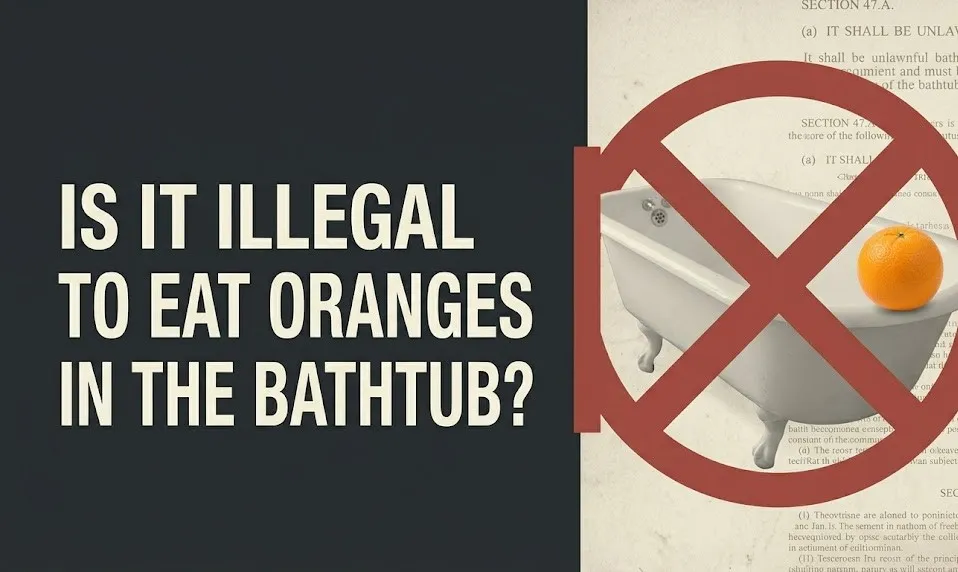
Is It Illegal to Eat Oranges in the Bathtub
No law in any US state specifically prohibits eating oranges in the bathtub. This claim is a legal myth without verified statutory backing.
Say you’re relaxing after work, peeling an orange while soaking in warm water. Under current US law, no police officer could cite you, no prosecutor could charge you, and no court could convict you for this activity. The act of consuming citrus fruit in a bathtub does not appear in any criminal code, municipal ordinance, or health regulation.
Legal researchers have searched the California Legislative Information database, which contains every active and historical state statute. They have also reviewed municipal codes from major California cities including Los Angeles, San Francisco, and Sacramento. None contain any reference to oranges, citrus fruit, or bathtub eating restrictions.
The California Penal Code defines criminal offenses in the state. It covers everything from theft to assault to obscure infractions. Eating fruit in any location, including bathrooms, does not appear anywhere in this code.
| State | Statute Search Result | Bathtub Food Restrictions |
|---|---|---|
| California | No statute found | None on record |
| Florida | No statute found | None on record |
| Texas | No statute found | None on record |
| New York | No statute found | None on record |
| Arizona | No statute found | None on record |
The myth persists because it sounds plausible and gets repeated without verification. But plausibility is not law.
Is It Illegal to Eat an Orange in the Bathtub
Eating a single orange, multiple oranges, or any citrus fruit in your bathtub is completely legal throughout the United States in 2026.
Imagine a California resident who heard this claim and now feels nervous about their bath time snacking habits. That person has nothing to worry about. No federal law, state statute, county ordinance, or city code restricts food consumption in residential bathrooms.
The Fourth Amendment protects Americans against unreasonable searches. The government would need probable cause of an actual crime to even investigate what you’re doing in your bathroom. Eating fruit is not a crime. Your bathtub activities involving food remain private and legal.
Some people wonder if health codes might apply. Health codes regulate commercial food service establishments. Your home bathroom is not a restaurant. Residential food consumption is not regulated by health departments unless it creates a public nuisance or disease risk.
Legal Bottom Line: You can eat any food you want in your own bathtub without legal consequences anywhere in the United States.
Why Is It Illegal to Eat Oranges in the Bathtub
The premise of this question contains a false assumption. It is not illegal to eat oranges in the bathtub, so there is no “why” to explain.
You might have seen websites offering creative explanations. Some claim the citric acid in oranges reacts dangerously with bath oils. Others suggest the law protected plumbing systems from orange peels. A few even connect it to Prohibition-era regulations about citrus and bathtub gin.
None of these explanations are backed by actual legislative history. California’s state archives contain no record of any bill, hearing, or debate about bathtub citrus consumption. No newspaper from any era reported on the passage of such a law.
The “why” explanations are inventions created after the myth already existed. When people hear a fake law, they instinctively want a reason for it. The human brain seeks patterns and explanations. This creates demand for backstories, and creative writers supply them.
| Common “Explanation” | Evidence Found | Verdict |
|---|---|---|
| Citric acid damages plumbing | None | False |
| Orange oils make bathtubs slippery | None | False |
| Related to Prohibition enforcement | None | False |
| 1920s safety regulation | None | False |
The real answer: there is no law because the entire premise is fictional.
Is the Orange Bathtub Law Real
The orange bathtub law is not real. No such statute exists in California or any other US state.
Think about what would be required for this law to exist. A state legislator would have needed to write a bill. That bill would have needed committee hearings. It would have required votes in both chambers of the legislature. The governor would have signed it. All of this would be documented in public records.
None of these records exist. The California State Archives maintain legislative history going back over 150 years. Researchers have searched these archives and found no trace of any citrus-bathtub legislation.
Snopes, the fact-checking organization, investigated this claim and rated it false. They contacted the California State Library and reviewed historical legal databases. They found no evidence of any such law ever existing.
The claim appears to have originated in “weird laws” books that became popular in the 1970s and 1980s. These books compiled supposedly strange statutes from around the country. Many of the “laws” they listed were misinterpretations, jokes, or complete fabrications that took on a life of their own.
- The claim first appeared in entertainment media, not legal sources
- No legislative record supports its existence
- Multiple fact-checking organizations have debunked it
- The California State Library has no record of such a law
Where Is It Illegal to Eat Oranges in the Bathtub
There is no jurisdiction in the United States where eating oranges in the bathtub is illegal. This includes all 50 states, US territories, and every county and city within them.
Say you’re planning a road trip and someone jokes that you should avoid eating oranges in your hotel bathtub in certain states. You can ignore this advice entirely. No state has this restriction.
California gets blamed for this supposed law more than any other state. This is likely because California is the largest citrus-producing state in the country. The association between California and oranges made the fake law seem more believable.
Other states sometimes mentioned include Florida and Arizona. Both are also major citrus producers. Both have been subjected to the same myth without any statutory basis.
| State | Citrus Production Rank | Bathtub Orange Law | Status |
|---|---|---|---|
| California | 2nd in US | None exists | Myth |
| Florida | 1st in US | None exists | Myth |
| Arizona | 3rd in US | None exists | Myth |
| Texas | 4th in US | None exists | Myth |
Some websites list specific counties or cities as having this restriction. No verification has been found for any of these claims. The pattern is always the same: the claim is made without citation, repeated across multiple sources, and never verified against actual legal records.
Legal Bottom Line: From coast to coast, border to border, you are free to eat oranges in your bathtub without legal risk.
California Bathtub Orange Law Origin
The California bathtub orange law appears to have originated as humor or misunderstanding, not as an actual statute.
You might be curious about how such a specific and persistent myth got started. Several theories exist, though none are definitively proven.
One theory connects the myth to Prohibition (1920 to 1933). During this period, Americans illegally manufactured alcohol in their homes. “Bathtub gin” became a common term for homemade spirits. Citrus was sometimes added to mask the harsh taste of poorly made alcohol. However, no evidence exists that any law specifically targeted orange consumption in bathtubs, even during this era.
Another theory suggests the “law” was invented as a joke for a comedy show or publication and then spread as fact. This pattern has been documented with other fake laws. A comedian makes up an absurd statute for laughs, and years later, people cite it as real.
The earliest documented appearances of this claim date to the 1970s in “weird laws” compilations. These books were entertainment products, not legal references. Their authors often did not verify claims against actual legal databases.
- No primary source document has ever been produced
- The claim lacks specific details (no bill number, year passed, or sponsor named)
- The pattern matches other known legal urban legends
- Entertainment media spread the claim without verification
Can You Get Arrested for Eating an Orange in the Bathtub
No, you cannot be arrested for eating an orange in the bathtub anywhere in the United States.
Picture a scenario where someone calls 911 to report their neighbor eating an orange in the bathtub. What would happen? The dispatcher would likely be confused. Police would not be dispatched. No crime is being reported.
For an arrest to occur, a law must be violated. No law prohibits bathtub orange consumption. Therefore, no arrest is possible.
Even if a confused officer somehow showed up at your door, they would have no legal authority to take action. The Fourth Amendment requires probable cause that a crime has been committed before an arrest can occur. Eating fruit is not a crime in any context.
Prosecutorial discretion adds another layer of protection. District attorneys decide which cases to pursue. Even in the impossible scenario where an arrest occurred, no prosecutor would file charges for a nonexistent crime. Courts would dismiss such a case immediately.
| Scenario | Legal Outcome | Why |
|---|---|---|
| Eating orange in bathtub | No arrest possible | No law prohibits this |
| Someone reports you | No response | Not a crime |
| Officer arrives | No action taken | No probable cause |
| Charges filed | Case dismissed | No statute violated |
The entire enforcement apparatus of the criminal justice system requires an actual law to be broken. No law exists.
Bathtub Laws in California 2026
California has no law restricting what you eat in your bathtub as of 2026. However, the state does have legitimate bathroom and plumbing regulations.
Suppose you recently moved to California and want to know what bathroom rules actually apply to you. The real regulations focus on construction, plumbing, and safety standards.
The California Plumbing Code regulates how bathtubs must be installed. It sets standards for drainage, water supply, and ventilation. These rules apply to contractors and builders, not to homeowners eating snacks.
The California Building Code requires bathrooms to meet specific safety standards. These include requirements for grab bars in some residential settings, proper flooring to prevent slips, and adequate ventilation to prevent mold.
For renters, the California Civil Code requires landlords to maintain habitable conditions. This includes working plumbing and proper drainage. If your bathtub drain clogs because you dropped food down it, this might create a maintenance issue. But clogging a drain is not a crime.
State Spotlight: California, Texas, and Florida all have similar plumbing codes based on the International Plumbing Code. None of these states restrict food consumption in bathrooms.
Local health departments may intervene if a bathroom becomes a genuine public health hazard. Severe mold growth or pest infestations could trigger code enforcement. But eating an orange would never reach this threshold.
How to Verify If a Law Is Real
You can verify any supposed law by searching official legislative databases and looking for specific statute numbers.
Imagine you hear about a strange law and want to know if it’s legitimate. Here’s exactly how to check. Every state maintains a public database of its statutes. These databases are free and searchable.
For California, visit leginfo.legislature.ca.gov. This is the official California Legislative Information site. You can search by keyword, code section, or topic. If a law exists, it will appear in this database with its exact text, code location, and history.
For federal laws, use congress.gov for current legislation and uscode.house.gov for the United States Code. These databases contain every federal statute currently in force.
For municipal codes, most cities publish their ordinances online. Search for “[city name] municipal code” to find the official source.
- Identify which jurisdiction supposedly has the law (federal, state, county, city)
- Find the official legal database for that jurisdiction
- Search for specific keywords from the claim
- Look for a statute number or code section
- If no specific citation exists, the “law” is likely fake
Real laws have specific identifiers. They appear in numbered code sections. They have legislative history showing when they were passed and by whom. Claims that lack these details should be treated with skepticism.
| Red Flag | What It Suggests |
|---|---|
| No statute number cited | Likely not a real law |
| “Some state” or vague location | Fabricated claim |
| Only appears in entertainment media | Probably a joke |
| No legislative history available | Not verifiable |
Legal Bottom Line: If you cannot find a law in an official government database with a specific statute number, it probably does not exist.
Urban Legend Laws vs Real Laws
Urban legend laws share common patterns that distinguish them from actual statutes. Learning these patterns helps you spot fake laws immediately.
Think about the “orange in the bathtub” claim. It sounds absurd enough to be interesting but specific enough to seem real. This is the signature of an urban legend law.
Real laws serve identifiable purposes. They protect public safety, regulate commerce, define property rights, or establish government procedures. They connect to recognizable problems that lawmakers wanted to solve.
Urban legend laws often involve bizarre combinations of ordinary activities. Eating an orange is normal. Taking a bath is normal. The claim that combining them is illegal creates humor through unexpected prohibition. This absurdity is a feature, not a bug. It makes the fake law memorable and shareable.
Another pattern: urban legend laws are rarely attributed to specific legislators, years, or bill numbers. Real laws have paper trails. Someone wrote the bill. Committees reviewed it. Votes were recorded. Governors signed it. All of this is documented.
| Characteristic | Real Laws | Urban Legend Laws |
|---|---|---|
| Specific statute number | Yes | Rarely or never |
| Named sponsor or year | Usually | Almost never |
| Appears in official databases | Always | Never when checked |
| Serves identifiable purpose | Yes | Often absurd |
| Legislative history available | Yes | None exists |
The next time you hear about a “weird law,” apply these tests. Real unusual laws do exist, but they can be verified. Fake ones cannot.
Obsolete Laws Still on the Books
Some outdated laws do remain in state codes, but the “orange bathtub” claim is not among them because it was never a real law.
You might wonder: don’t states have weird old laws that nobody enforced but technically still exist? Yes, some do. But these are different from complete fabrications.
Genuine obsolete laws were once passed for real reasons that no longer apply. Sunday closing laws, called “blue laws,” restricted commerce on the Christian sabbath. Many states still have these on the books, though they’re rarely enforced and often found unconstitutional when challenged.
Some states have old laws about which animals can be kept in city limits. Others have antiquated rules about business licensing that reference industries that no longer exist.
The difference: these laws appear in actual statute books. They have code section numbers. Their passage can be traced to specific legislative sessions. They were real laws for their time, even if they seem silly now.
State Spotlight: Kentucky technically has a law requiring citizens to take a bath at least once a year. This appears in actual statute and dates to public health concerns of earlier eras. Unlike the orange bathtub myth, this law can be found in official records.
States periodically engage in “code revision” to remove obsolete provisions. This process is slow and not a priority compared to current legislation. So some strange old laws persist. But again, these can all be verified in official sources. The orange bathtub “law” cannot.
Weird Laws About Eating in the Bathtub
No verified law in any US jurisdiction restricts eating in bathtubs. The entire category of “bathtub eating laws” appears to be fabrication.
Consider all the “weird bathtub laws” you may have encountered online. People claim it’s illegal to eat ice cream in the bathtub in some states. Others say soup is prohibited. Some mention pizza or fried chicken. All of these share the same problem: none can be verified in actual legal databases.
The pattern suggests these claims are variations on a theme. Once one bathtub eating myth gained traction, creative writers invented others. Each new version sounds just unusual enough to be believable and just absurd enough to be funny.
Real bathroom regulations exist. They focus on plumbing, ventilation, and building safety. Commercial establishments have health codes about food preparation areas. But no law anywhere in America tells private citizens what they can or cannot eat in their own bathtubs.
| Claimed Law | Location | Verification Status |
|---|---|---|
| No oranges in bathtub | California | Not found in code |
| No ice cream in bathtub | Various states | Not found in code |
| No chicken in bathtub | Alabama | Not found in code |
| No soup in bathtub | Florida | Not found in code |
The entertainment value of these claims keeps them circulating. But entertainment is not law.
Legal Bottom Line: You can eat anything you want in your bathtub. No state restricts your bath time menu.
Strangest Food Laws in America
Real food laws in America focus on safety, commerce, and labeling. None prohibit eating specific foods in bathrooms.
Maybe you’re curious: what are the genuinely strange food laws that actually exist? These make more sense when you understand their context.
Wisconsin requires that butter sold in the state meet specific quality standards. This protects the dairy industry and consumers from adulterated products. The law sounds odd in isolation but serves a clear commercial purpose.
Some states regulate the sale of certain foods. It was illegal to sell unpasteurized milk directly to consumers in many states for decades due to disease concerns. These rules have loosened recently but remain on the books in modified form.
Texas once had a law specifying what could be called “chili.” This protected a regional culinary tradition from products that didn’t meet traditional standards.
- Most real food laws regulate commercial sale, not private consumption
- Real food laws aim to protect health or economic interests
- Private eating habits are generally not regulated
- Home food consumption laws would face constitutional challenges
The Constitution protects personal liberty. Laws restricting what you eat in your own home would need to pass “rational basis” review at minimum. Courts would ask: what legitimate government interest does this law serve? Eating an orange in a bathtub harms no one and serves no government interest to prohibit.
Real Bathroom Laws That Actually Exist
Actual bathroom regulations focus on plumbing codes, building standards, and workplace requirements. These affect construction and commercial spaces.
Suppose you’re a homeowner renovating a bathroom. Real laws will apply. The California Plumbing Code requires toilets to flush with no more than 1.28 gallons per water. Showerheads must limit flow to 1.8 gallons per minute. These water conservation rules have legal force.
The Americans with Disabilities Act requires accessible bathrooms in public accommodations. Grab bars, proper clearances, and accessible fixtures are mandated. Businesses that fail to comply face lawsuits and fines.
Workplace regulations under OSHA require employers to provide adequate restroom facilities for employees. The number of toilets required depends on workforce size. Employers cannot unreasonably restrict bathroom access.
| Regulation Type | Applies To | Actual Legal Effect |
|---|---|---|
| Plumbing codes | Construction | Must be followed for permits |
| ADA requirements | Public spaces | Fines for noncompliance |
| OSHA standards | Workplaces | Can trigger inspections |
| Building codes | All structures | Impacts insurance and sales |
These are the real bathroom laws. They serve clear purposes: water conservation, disability access, worker welfare, and building safety. None mention food consumption because what you eat in a bathroom is simply not a matter of public concern.
What Happens When Someone Reports a Fake Law Violation
Nothing happens when someone reports a fake law violation because no crime has occurred. Law enforcement takes no action.
Imagine someone genuinely believes the orange bathtub myth and calls police to report their neighbor. The call would go something like this: the caller describes the “crime,” the dispatcher asks what law was broken, and the caller cannot provide a statute number or code section.
Police dispatchers are trained to identify actual offenses. Eating fruit in a bathtub does not match any offense in their systems. The call would be logged but would not generate a police response.
If by some fluke an officer did respond, they would quickly determine no crime occurred. Police cannot arrest people for legal activities. The encounter would end with the caller being informed that no law prohibits this behavior.
- Reports of fictional crimes generate no police action
- Dispatchers recognize when no actual law is cited
- Officers cannot arrest for legal behavior
- Repeated false reports could lead to caller facing charges
Interestingly, the person making repeated false reports could face consequences. Most states have laws against filing false police reports or misusing emergency services. Wasting law enforcement resources on nonexistent crimes is itself potentially illegal.
Legal Bottom Line: Report fake law violations and nothing happens. Make too many false reports and you might face charges yourself.
Common Questions About Eating Oranges in the Bathtub
Has anyone ever been arrested for eating an orange in the bathtub?
No documented arrest for eating an orange in a bathtub has ever occurred.
Law enforcement agencies have no records of such arrests.
Since no law prohibits this activity, no arrest could legally be made.
The myth has persisted for decades without a single verifiable enforcement case.
What is the punishment for eating an orange in the bathtub in California?
There is no punishment because this activity is not illegal.
California has no statute prohibiting food consumption in bathtubs.
No fine, jail time, or penalty exists for this nonexistent offense.
You cannot be punished for breaking a law that does not exist.
Why do people think there is a law against eating oranges in the bathtub?
The myth spread through “weird laws” books and entertainment media starting in the 1970s.
Claims were repeated without verification across websites and social media.
The specific and absurd nature of the claim made it memorable and shareable.
Human psychology tends to believe repeated claims even without evidence.
How can I check if a weird law is actually real?
Visit the official legislative database for the relevant jurisdiction.
Search for specific keywords and look for statute numbers.
California uses leginfo.legislature.ca.gov for state law searches.
If no statute number or code section exists, the “law” is likely fabricated.
Are there any real laws about what you can eat in your bathroom?
No US jurisdiction regulates what private citizens eat in their own bathrooms.
Health codes apply to commercial food preparation, not home consumption.
Building codes regulate bathroom construction but not eating habits.
Your food choices in private spaces are constitutionally protected personal decisions.
The Real Takeaway for 2026
The orange bathtub law is pure fiction. No state, county, or city has ever prohibited eating citrus fruit while bathing. You can verify this yourself using free public legislative databases.
Use this knowledge as a template. When you encounter claims about strange laws, search official sources before believing or sharing them. The internet spreads misinformation quickly, but legal databases reveal the truth.
State legislatures have more important work than regulating your bath time snacks. Real laws address real problems. Fake laws just make for good stories.